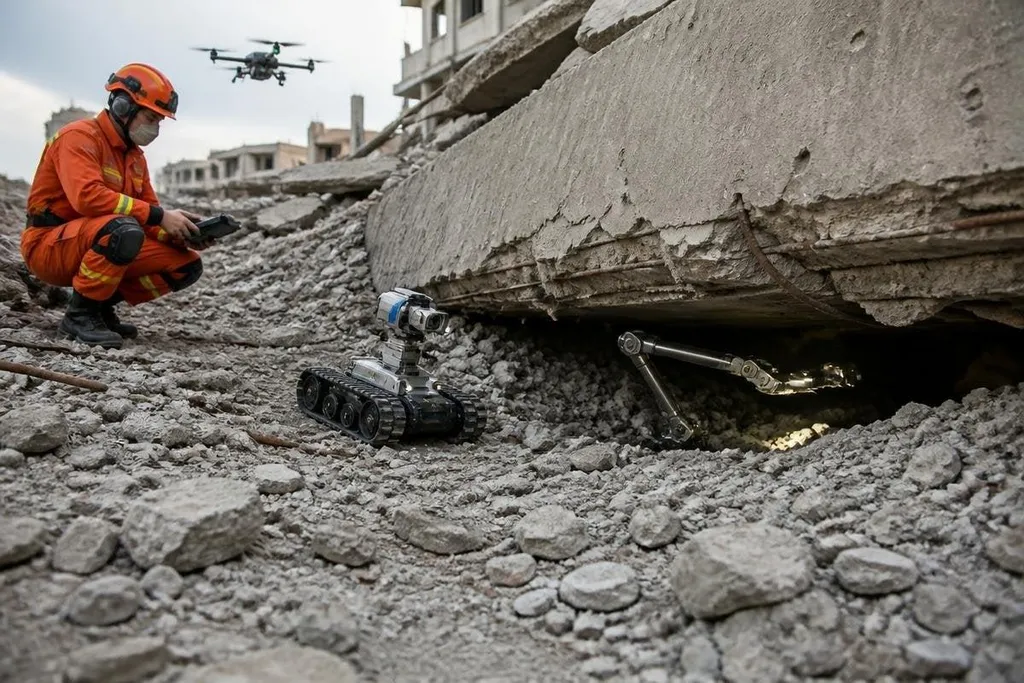
A collapsed building can leave narrow gaps that rescuers cannot enter safely. Small ground robots, drones, and robotic arms can inspect those gaps, send back images, and help teams decide where to search first.
Their job is to give rescuers better information without putting another person in danger.
- Small robots can enter gaps, tunnels, and unstable rooms.
- Cameras, microphones, and gas sensors can check conditions from a distance.
- Rescue teams still need people to confirm a survivor and plan the extraction.
What the robots do first
A tracked ground robot can move over broken concrete, dust, and loose material. Its camera sends video to an operator, who can look around corners or inspect a room before a rescuer enters.
The robot may also carry a microphone. A faint voice, tapping sound, or movement can point the team toward a possible survivor. That clue does not prove someone is there, but it can help crews choose where to spend time.
A drone offers a different view. It can fly over a damaged site, check roofs and courtyards, and show blocked roads that may affect access. In a large disaster area, that view can help teams plan routes before heavy equipment arrives.
Sensors turn a gap into useful information
Video is only one part of the search. A thermal camera can show heat patterns, though dust, concrete, clothing, and other objects can affect what it sees. The operator needs to read that image with care.
LiDAR measures distance with pulses of light and builds a map of nearby surfaces. That map can show the shape of a passage and help a robot avoid walls or debris. The record can also tell rescuers which spaces have already been checked.
Gas sensors can warn about hazards such as low oxygen or leaking fuel. A robotic arm may move a small object, place a camera in a better position, or carry a radio near a trapped person. Each tool answers a different question, so the robot needs the right sensor for the site.
The connection matters as much as the sensor. Reinforced concrete can weaken radio signals, and dust or damage can block a clear route. A tethered robot avoids some signal problems, but its cable can snag on rubble and limit how far it travels.
Where human control still matters
Most rescue robots need an operator for the hard decisions. Software can help with mapping, obstacle warnings, or image sorting, but it can't reliably decide whether a cracked wall will collapse after the robot passes.
The operator also has to judge false alarms. A warm pipe may look like a person on a thermal camera. A loose piece of metal may create a sound. Rescue crews need more than one clue before they send people into a dangerous space.
This is why a robot should work as part of a search team. The system can inspect, map, and report. People decide what the information means and how to reach the site.
A rescue robot’s map only helps if crews can act on it. Disaster robotics reporting can show the test site, date, sensor setup, and operator role behind a machine’s claim, giving you a fair way to judge its use after a quake before the next section examines its limits.
The limits after a real quake
A robot can lose traction on steep rubble. Dust can cover a lens. A falling slab can damage the chassis, and a dead battery can end a search at the worst time. Drones face wind, smoke, wires, and the short flight time of battery-powered aircraft.
Training creates another limit. Rescue crews must know how to drive the robot, read its sensors, change batteries, and recover it when it gets stuck. That work takes time before an earthquake happens.
I'd choose a rescue team with a smaller robot that crews can operate well over a larger system that spends most of its time waiting for a specialist. The machine has to fit the team, the building, and the radio plan.
A practical buying and planning checklist
Before adding a rescue robot to an emergency plan, check these points:
- Match the body to the site: choose wheels, tracks, legs, or flight based on the rubble and spaces the team expects.
- List the sensors: confirm the robot carries the camera, microphone, thermal camera, or gas sensor the search needs.
- Test the radio path: check control and video links through concrete, metal, dust, and damaged rooms.
- Plan power and recovery: store charged batteries and decide how operators retrieve a stuck robot.
- Train the full crew: practise driving, sensor checks, handoffs, and safe shutdowns before deployment.
The next useful step is not a more dramatic demo. It is a field test with rescue crews, damaged-building layouts, weak radio links, and a clear record of what the robot found. Until that work is done, these machines are best treated as search tools that extend human reach, not replacements for rescuers.